There was some semblance of law and order in 2006, when the Islamic Courts Union, loosely linked with Al Qaeda, took over much of the country and imposed Shariah law. Though there were cruel tradeoffs, the Islamists virtually eradicated piracy. (The crime was a capital offense punishable by beheading.)John Burnett appears to be totally clueless about recent Somalia history; I wonder how he could get this article published in the New York Times. The ICU did not eradicate piracy, it was simply never as much of a problem as it is now. They did outlaw it, but the fact is the ICU never had any authority over the area where most of piracy comes from: Puntland. Here is a map that shows that maximum extent of ICU power (dark green).
When Ethiopian forces, supported by the United States, replaced the Islamists with an ineffective transitional government in 2006, piracy returned with an intensity not seen since the 17th century.It is evident that no nation can impose its will on Somalia; the colonial British and Italians learned the hard way. And certainly no nation can force Somalis to stop the best business in town. But if the West really hopes to eliminate the scourge of piracy in these strategic shipping lanes, then it should consider involving the courts union, the only entity that has proved it could govern the country, and its militant wing, Al Shabaab, in a new government. -John Burnett
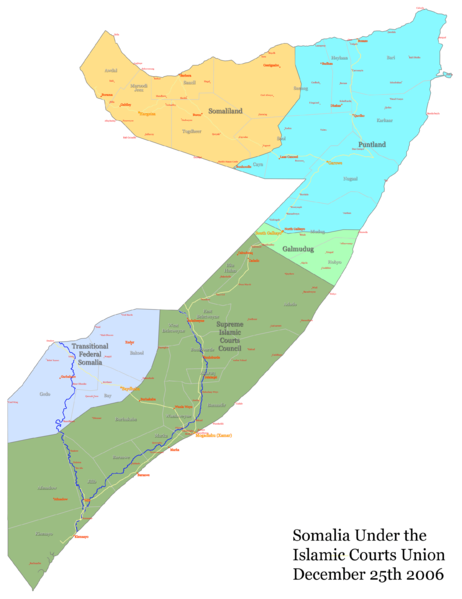 As you can see the Islamic Courts never controlled more than half of the country because, like the Transitional Government, it was an organization that was based mostly on clan affiliation and was thus opposed by the other clans. In this regard it is very similar to the Taliban in Afghanistan, who drew their support from Pashtuns despite their Islamic rhetoric, except that the Taliban actually controlled the vast majority of the country when the USA invaded. There is nothing that could lead us to believe that the ICU could control all of Somalia. Even if they did, I do not see how you could argue for support of a movement that stone to death teenage girls for being raped (while not punishing the rapists) for the purpose of saving a few tens of millions to shipping companies; the fact is that piracy is not a huge problem, it is a nuisance that can be controlled.




 Posts
Posts

