Showing posts with label Internal instability. Show all posts

Saturday, December 6, 2008

How not to solve the piracy problem

There was some semblance of law and order in 2006, when the Islamic Courts Union, loosely linked with Al Qaeda, took over much of the country and imposed Shariah law. Though there were cruel tradeoffs, the Islamists virtually eradicated piracy. (The crime was a capital offense punishable by beheading.)

When Ethiopian forces, supported by the United States, replaced the Islamists with an ineffective transitional government in 2006, piracy returned with an intensity not seen since the 17th century.

It is evident that no nation can impose its will on Somalia; the colonial British and Italians learned the hard way. And certainly no nation can force Somalis to stop the best business in town. But if the West really hopes to eliminate the scourge of piracy in these strategic shipping lanes, then it should consider involving the courts union, the only entity that has proved it could govern the country, and its militant wing, Al Shabaab, in a new government. -John Burnett
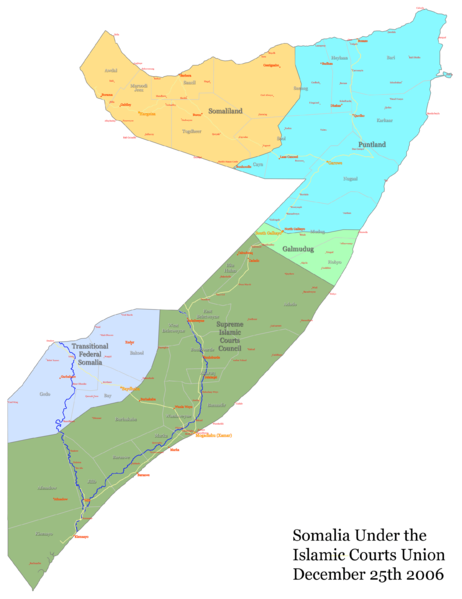
John Burnett appears to be totally clueless about recent Somalia history; I wonder how he could get this article published in the New York Times. The ICU did not eradicate piracy, it was simply never as much of a problem as it is now. They did outlaw it, but the fact is the ICU never had any authority over the area where most of piracy comes from: Puntland. Here is a map that shows that maximum extent of ICU power (dark green). As you can see the Islamic Courts never controlled more than half of the country because, like the Transitional Government, it was an organization that was based mostly on clan affiliation and was thus opposed by the other clans. In this regard it is very similar to the Taliban in Afghanistan, who drew their support from Pashtuns despite their Islamic rhetoric, except that the Taliban actually controlled the vast majority of the country when the USA invaded. There is nothing that could lead us to believe that the ICU could control all of Somalia. Even if they did, I do not see how you could argue for support of a movement that stone to death teenage girls for being raped (while not punishing the rapists) for the purpose of saving a few tens of millions to shipping companies; the fact is that piracy is not a huge problem, it is a nuisance that can be controlled.

Not the smartest fish in the pond

Sometimes, it is better not to say anything at all.

The insurgents were invisible, hidden behind the thick mud walls of the compounds, their rifles poking through narrow slits.

“Small arms have no effect on the walls, and that’s what we were carrying,” Colonel Baluch said. “We did not know where to fire back.”

The attack came from three directions, but the guerrillas made a mistake.

“When they shouted, ‘God is great,’ it was helpful to us,” Colonel Baluch said. The voices gave away their location. -NYTimes (Jane Perlez and Pir Zubair Shah)

Tuesday, December 2, 2008

Thailand PM steps down and protests called off

The constitutional court ordered Mr Somchai, the Prime Minister, to back down (at least temporarily) and to disband his party and his allies. This is the second time in less than a year that a Prime Minister from the PPP, the party allied with Thaksin Shinawatra, has been forced to resign by the court. In return, the protesters have agreed to leave the airport.

So the currents crisis seems to be calming down but it did not solve any issue and it is unclear who will run the country now and violence is still a very likely possibility. Thaksin and his allies remain as popular as ever and whoever he backs will probably get elected in the next elections, the protesters did not get more than tacit support from the army and did not manage to get the changes they wanted to remain a force in Thai politics (that is a non-representative voting system). So all in all it is hard to see who "won" in the troubles of the last few months, we will have to see how things pan out in the next few days, but I'd have to vote for Thaksin and his friends as the "winners".

Monday, December 1, 2008

Thailand update 01/12/08

Things are moving slowly in Thailand, and it seems things are looking brighter for the government. As I said Friday, I think the protesters overplayed their hand by occupying the airport; they lost the support of the business community by effectively strangulating the economy. The police has been blockading the protesters at the airport by occupying checkpoints, but they have not dared to forcibly remove the protesters. The government probably fears that if there is blood while they remove the protesters, the army will use this as an excuse to take the side of PAD. So they attempt to deal with the situation as smoothly as possible. The army has refused to get involved up until now, even though it is well known that they support PAD.

The protesters are still occupying the two airports but they are leaving government offices they had taken months ago to concentrate on the airports, which is a sign that they are stretched thin. They have struck a deal with the government to allow some flights and also alternative airports are being used all over Thailand; so people can fly in and out now. But the image of Thailand is taking a hit and every day that the airport protests continue, more tourists will cancel their trip or go elsewhere; so the business community will probably be forced to side with the government even if they do not like them. The protesters last chance is to force the hand of the army to get involved and they will do so by attempting to play martyr.

Friday, November 28, 2008

Friday Thailand update

The crisis continues. The cabinet, currently meeting in the northern city of Chang Mai, has called an emergency situation at the two Bangkok airport and told the protesters to go away. The police has surrounded the airports but have not yet tried to forcibly remove them yet. Today the Prime Minister, Mr Somchai, dismissed the head of police and replaced him. The reasons are unclear but more than likely he did not want to follow orders from Chang Mai.

The BBC claims the Prime Minister has lost the confidence of the army chief, General Anupong Paochinda, but the implications are not clear. Many are talking about a potential coup, but the question I asked yesterday remains: if the army wanted to do another coup, why didn't they do it when Mr Somchai was out of the country earlier this week? Now they are in a tough situation because the government is in the north where they have widespread support. Deposing the government in that situation would be risky and the end result highly unpredictable.

But the longer the airport remains occupied, the more the business community will turn against the prosters. From the BBC:

Correspondents say the airport protesters appear increasingly isolated and are losing the support of their traditional sympathisers, the business elite.

The airport closure will cost the country around $4bn (£2.6bn) in lost business and cause serious damage to its reputation as a tourist destination, something which will take the country years to recover from, say analysts.

I think the protesters might have overplayed their hand here. By blocking the airports they are cutting the lifeline to tens of thousands of people who rely on it for business. Their financial interests force them to side with the government now even if their hearts might be with the protesters. The other option would be a military coup but it would be more risky as pro-government counter protests could continue to disrupt the economy or force a bloody repression that would ruin Thailand's image as a tourist destination for years.

My reading of the situation is that the government will end up winning and the PAD protesters will be dispersed.

Thursday, November 27, 2008

Thailand update: state of emergency and call to resign

Thailand's government cabinet has met in the northern city of Chang Mai. They decided to declare a state of emergency limited to Bangkok's two airports in order to remove the protesters who still block all flights. It is still unclear how and if it will be enforced. Yesterday, the head of the army called the Prime Minister, Somchai Wongsabat, to resign and call snap elections. So it is unclear whether the army will side with the government against the protesters if forced to make a choice. General Anupong refused to enforce a state of emergency to clear protesters from government office two months ago, but the airports are much more important to the nation's economy, and he himself has called the protesters to leave.

An interesting development is that the army has allowed Mr Somchai back in the country (or at least did not bar his return) from an international meeting in Peru yesterday. This seems to suggest that the army does not intend to do a coup as they would have more than likely done it when he was out of the country, as they did to Thaksin in 2006. But maybe there is internal dissent in the army over the course of action to take, so I think all options are still on the table. The showdown continues.

Tuesday, November 25, 2008

Thailand update

The PAD protesters have surrounded the airport, delaying flights and causing headaches for tourists; but more importantly they are pressuring the government because the cabinet is now meeting in offices at the airport, because crowds have been surrounding the Parliament and government offices making it impossible to use those.

The situation is very tricky. The military coup worked only temporarily in 2006 for the Bangkok elites, they lost again to Thaksin's allies in 2007. That is the whole problem of this "revolution", Thaksin was ousted in a coup in 2006, but then his allies won in 2007, so the government's supporters (rightfully) believe they have a very strong claim to power. If the PAD manages to bring down government, there will be a lot of anger that could lead to civil unrest. There is an interesting article at the BBC on the class and regional struggle that are behind the political divisions (which I mentioned yesterday).

The army appears to be siding with the PAD, but what will they do if the government asks it to clear the protesters? They will probably refuse but what if there is internal dissension over this, with some officer attempting to rise in power by siding with the elected government, who agrees to do it. Could we see a breakdown of Thailand and a descent into some sort of civil war if the rest of the army side with PAD?

I doubt it. If things get too bad, the King can intervene and he has enough moral authority to stop serious troubles (I think). But things are looking bad for Thailand. Either the Bangkok elites accept the democratically elected government or they manage to take power and use the army to suppress dissidents. Let's hope they go for the former.

Monday, November 24, 2008

The Thailand protests in a paragraph

Protests against the government are ongoing in Thailand, with tens of thousands of protesters surrounding the parliament. They are led by the People's Alliance for Democracy (PAD), who claims that the government is corrupt and hostile to the monarchy. What is going on? Well the current government, led by Somchai Wongsawat, is widely seen as a pawn of Thaksin Shinawatra, who was ousted in a military coup in 2006. Thaksin is unpopular with Bangkok elites, but widely loved in the countryside. They managed to get him out of power in 2006, through protests and a military coup, but it was temporary. The protest is an attempt by this segment of the population to control the government more permanently. "The PAD wants to replace Thailand's one-man, one-vote system with one in which some representatives are chosen by professions and social groups rather than the general electorate." according to the BBC. In other words, they are protesting against democracy.