That is the price country pays for having failed states as neighbors. As the pressure became too great on the LRA in Uganda, they fled to South Sudan. When the fighting became problematic there they established bases in Democratic Republic of the Congo. And now that the governments of South Sudan, DRC and Uganda has jointly attacked the LRA, they have moved further northwest to CAR. If the LRA had been operating in Germany or in Malaysia, they would have had no choice but to abdicate after the pressure got too high in their country; there were simply no weak neighbors keep on fighting.
The LRA claims its whole leadership survived last week's attack. This is not too surprising given their skills at avoiding military strikes in the past. But although the guerrilla is alive and well, there is no escaping the fact that it is on the run and it is getting farther and farther from Uganda. While it is not the optimal solution for Northern Uganda, the distance between them and Kony allow reconstruction to happen and a semblance of normal life to restart. Hopefully by the time (and if) the LRA comes back, Acholi communities and the Ugandan government will be resilient enough to withstand them. As for CAR, god bless them; the last thing they needed was yet another rebel group.
Showing posts with label Africa. Show all posts
Showing posts with label Africa. Show all posts
Monday, December 22, 2008


Sunday, December 21, 2008
The changing Darfuris
There is a fascinating article in the NY Times that describes the increasing power of youths in Darfur's camp. What I found interesting is how their years in the camp changed their perspective on life:
But as the article says, the youths have very high expectations:
Before the conflict they were (mostly) uneducated farmers with very little understanding of the wider world. But the experience in the war and the camps, with its politicization and western based NGO education, has broadened their horizon. This new awareness is a bad sign for the sheiks and other traditional Darfuri power brokers. As the article shows, the newly politicized youths are now taking over power in the camps. It is also a cause for concern for Khartoum, as controlling Darfur was easier when the populace was by and large uneducated and predominantly under the control of local chieftains.“Before, our desires were simple when it came to education, to culture — all we really thought about was farming,” said Adam Haroun Ahmed, 20, who arrived in the camp at 15. “The colonization, the oppression, all the brutal things done to us by the janjaweed caused us to change our views.”
When asked to describe his old village, his school friends jostling around him shouted down the idea. “It is something in the past, almost imaginary,” one yelled. Another chimed in, “It is so far from our reality that we don’t want to be there.” -Neil Macfarquhar
But as the article says, the youths have very high expectations:
Mr. Abdullah reeled off four prerequisites before the shabab in any camp would agree to negotiations between Darfur rebels and the government: disarming the government militias; prosecuting those responsible for war crimes, starting with Mr. Bashir; expelling anyone who settled on land stolen from the displaced farmers; and carrying out all United Nations Security Council resolutions on Darfur.Just like in the Palestinian refugee camps, education and politicization bred extremism and unrealistic expectations. This recipe did not exactly bring lasting peace in Palestine, let us hope the results will be more suitable in Darfur.
Monday, December 15, 2008
He sure proved them wrong
He might have been old, but he sure as hell was not cranky.
DAKAR (Reuters) - A 70-year-old man opened fire with his hunting rifle on a rap group at a concert in northeast Senegal at the weekend because he felt their song lyrics were insulting him, police and local media said on Monday.
Five young people were wounded in the shooting incident at Lobali village in the Matam region on Senegal's border with Mauritania, some 700 km (440 miles) from the capital Dakar.
The man told the rappers to stop when they started singing about a "cranky old man", and when they did not, he opened fire with his rifle, a local police officer said.
Sunday, December 14, 2008
Civil War to restart in South Sudan?
There has been clashes in the oil-rich Southern Sudanese town of Abyei between Sudanese government soldiers (who were violating ceasefire agreement by being in the city) and the Southern Sudanese police, causing several thousands people to flee. The Sudanese troops have withdrawn for now but this is a bad sign. Both factions want to control this oil-rich region; Khartoum is deriving most of its foreign currency from it and the Southern Sudanese government knows it can not win if the Sudanese government controls the oil fields. This might be the first step toward faltering of the Comprehensive Peace Agreement signed in 2005 in Sudan and a return to the civil war which gripped the country for over 40 years. If this is correct, this is one of the saddest news of 2008, even for a skeptic like me who never believed too much in the CPA (but I still had a bit hope).
In seemingly unrelated news, DR Congo, Uganda and Southern Sudan have attacked LRA positions over the past days, breaking the peace process. Kony (LRA's leader) did not agree to sign a peace deal because of the ICC warrant on his head, (although it might be because after decades in the bush, he can not envision living any other way) so the governments of the region decided to attempt to eliminate him instead in a coordinated strike. Although it might not look connected to Abyei, it is. If the civil war is reignited in Sudan, the LRA will once again get funding and help from Khartoum; they will be in a stronger position and more difficult to deal with, causing more violence and destruction. That is why I said it was very important to reach a peace deal with Kony before the Comprehensive Peace Agreement in Sudan fell apart.
Let's hope the region does not fall apart.
In seemingly unrelated news, DR Congo, Uganda and Southern Sudan have attacked LRA positions over the past days, breaking the peace process. Kony (LRA's leader) did not agree to sign a peace deal because of the ICC warrant on his head, (although it might be because after decades in the bush, he can not envision living any other way) so the governments of the region decided to attempt to eliminate him instead in a coordinated strike. Although it might not look connected to Abyei, it is. If the civil war is reignited in Sudan, the LRA will once again get funding and help from Khartoum; they will be in a stronger position and more difficult to deal with, causing more violence and destruction. That is why I said it was very important to reach a peace deal with Kony before the Comprehensive Peace Agreement in Sudan fell apart.
Let's hope the region does not fall apart.
Saturday, December 6, 2008
How not to solve the piracy problem
There was some semblance of law and order in 2006, when the Islamic Courts Union, loosely linked with Al Qaeda, took over much of the country and imposed Shariah law. Though there were cruel tradeoffs, the Islamists virtually eradicated piracy. (The crime was a capital offense punishable by beheading.)John Burnett appears to be totally clueless about recent Somalia history; I wonder how he could get this article published in the New York Times. The ICU did not eradicate piracy, it was simply never as much of a problem as it is now. They did outlaw it, but the fact is the ICU never had any authority over the area where most of piracy comes from: Puntland. Here is a map that shows that maximum extent of ICU power (dark green).
When Ethiopian forces, supported by the United States, replaced the Islamists with an ineffective transitional government in 2006, piracy returned with an intensity not seen since the 17th century.It is evident that no nation can impose its will on Somalia; the colonial British and Italians learned the hard way. And certainly no nation can force Somalis to stop the best business in town. But if the West really hopes to eliminate the scourge of piracy in these strategic shipping lanes, then it should consider involving the courts union, the only entity that has proved it could govern the country, and its militant wing, Al Shabaab, in a new government. -John Burnett
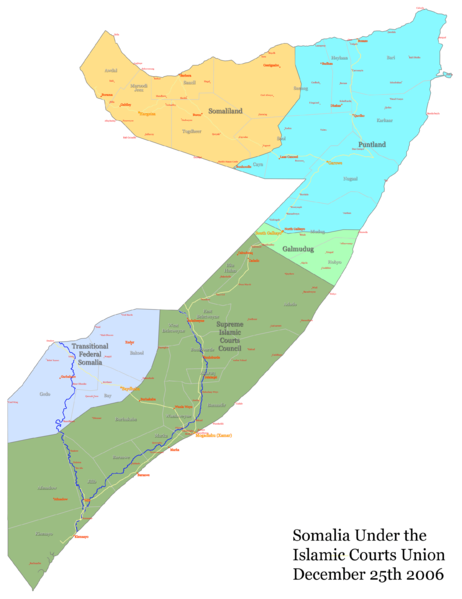 As you can see the Islamic Courts never controlled more than half of the country because, like the Transitional Government, it was an organization that was based mostly on clan affiliation and was thus opposed by the other clans. In this regard it is very similar to the Taliban in Afghanistan, who drew their support from Pashtuns despite their Islamic rhetoric, except that the Taliban actually controlled the vast majority of the country when the USA invaded. There is nothing that could lead us to believe that the ICU could control all of Somalia. Even if they did, I do not see how you could argue for support of a movement that stone to death teenage girls for being raped (while not punishing the rapists) for the purpose of saving a few tens of millions to shipping companies; the fact is that piracy is not a huge problem, it is a nuisance that can be controlled.
Monday, December 1, 2008
Lord's Resistance Army refuses to sign peace because of ICC
Kony, the reclusive leader from one of the worst guerrilla group in the world, the Lord's Resistance Army (LRA) of Northern Uganda, has refused to sign a peace deal this weekend that he was apparently supposed to sign. "Kony says he will not sign until the issue of the ICC (International Criminal Court) is resolved, until the deferrals are made," according to Riek Machar, the vice president of South Sudan. The ICC issue is that Kony has been indicted for war crimes at the international court and it has proven to be a problem because the bureaucrats at The Hague refuse to negotiate. For them no deal is possible because Kony is a war criminal and should be brought to justice.
The LRA is one of the world's deadliest rebel groups. It has been in the field for over 20 years, mainly in Northern Uganda but also with bases in DR Congo and Southern Sudan. They have a reputation for being very dangerous and unpredictable, for raping entire villages and for forcing child to kill their family so that they can not go back in their villages before enrolling them as child soldiers. They have displaced over two millions people and killed several thousands.
So Kony IS a war criminal, there is no doubt about that. But the issue here is realism vs justice. Those who thinks western conception of justice should be imposed all over the world no matter the costs will applaud the ICC's attitude with the LRA. They think the population in the region will suffer greatly but it is all for the greater good of mankind. The logic being that when other rebel leaders see they can not escape ICC indictment, they will stop doing war crimes and the planet will be a better place (criminal law has not exactly stopped people in the west from doing crimes although it has probably reduced the number). These are very noble intentions.
But the other side of the argument is that the LRA, the Ugandan government, the Southern Sudan government and the people directly involved by the rebellion (Acholi in Northern Uganda being the main group) desperately want peace. The guerrilla has been operating for 20 years, making normal life totally impossible in the region, even though the rest of the country has been happy, prosperous and stable for that timeframe, growing at 6% a year. The people merely want to be able to lead normal lives and for this, they are ready to forgive Kony. Kony has repeatedly said over the past two years that he is ready for peace and that he wants a place to retire, but it is impossible because of the ICC warrants. Since the ICC has no power to arrest Kony and destroy the LRA, all this does is force the conflict to continue even though all parties involved wants it to end. In other words, the bureaucrats from The Hague have decided to make the people from this region continue to suffer for an untold number of years for their abstract conception of justice. The window for peace might be closing as the CPA elections and referendum in Sudan might reignite the civil war. If it restarts, Kony will most certainly receive heavy backing from Khartoum as he did before, and might not be amenable for negotiations for years to come.
This story has gone mostly unreported in the western world because Africans suffering and dying apparently does not make for an interesting news story. But I hope that at least the men and women working at the ICC realizes the cost they are asking the poorest people in the world to bear for their vision of justice. I hope they have trouble sleeping at night sometimes, because the people of Northern Uganda have been having nightmares for more than 20 years.
The LRA is one of the world's deadliest rebel groups. It has been in the field for over 20 years, mainly in Northern Uganda but also with bases in DR Congo and Southern Sudan. They have a reputation for being very dangerous and unpredictable, for raping entire villages and for forcing child to kill their family so that they can not go back in their villages before enrolling them as child soldiers. They have displaced over two millions people and killed several thousands.
So Kony IS a war criminal, there is no doubt about that. But the issue here is realism vs justice. Those who thinks western conception of justice should be imposed all over the world no matter the costs will applaud the ICC's attitude with the LRA. They think the population in the region will suffer greatly but it is all for the greater good of mankind. The logic being that when other rebel leaders see they can not escape ICC indictment, they will stop doing war crimes and the planet will be a better place (criminal law has not exactly stopped people in the west from doing crimes although it has probably reduced the number). These are very noble intentions.
But the other side of the argument is that the LRA, the Ugandan government, the Southern Sudan government and the people directly involved by the rebellion (Acholi in Northern Uganda being the main group) desperately want peace. The guerrilla has been operating for 20 years, making normal life totally impossible in the region, even though the rest of the country has been happy, prosperous and stable for that timeframe, growing at 6% a year. The people merely want to be able to lead normal lives and for this, they are ready to forgive Kony. Kony has repeatedly said over the past two years that he is ready for peace and that he wants a place to retire, but it is impossible because of the ICC warrants. Since the ICC has no power to arrest Kony and destroy the LRA, all this does is force the conflict to continue even though all parties involved wants it to end. In other words, the bureaucrats from The Hague have decided to make the people from this region continue to suffer for an untold number of years for their abstract conception of justice. The window for peace might be closing as the CPA elections and referendum in Sudan might reignite the civil war. If it restarts, Kony will most certainly receive heavy backing from Khartoum as he did before, and might not be amenable for negotiations for years to come.
This story has gone mostly unreported in the western world because Africans suffering and dying apparently does not make for an interesting news story. But I hope that at least the men and women working at the ICC realizes the cost they are asking the poorest people in the world to bear for their vision of justice. I hope they have trouble sleeping at night sometimes, because the people of Northern Uganda have been having nightmares for more than 20 years.
Thursday, November 27, 2008
Today in the World: South Africa
South Africa will continue to manage its economy with restraint after next year's elections, despite pressure from leftist allies seeking to adopt more expansionary policies, ruling ANC leader Jacob Zuma said.Zuma, who is likely to become president after the elections, told the American Chamber of Business late on Wednesday that the government would maintain the policies that had spurred a decade of strong growth and prepared the country well for the choppy economic waters ahead.
"We are proud of the fiscal discipline, sound macro-economic management and general manner in which the economy has been managed. That calls for continuity," he said in a copy of his speech. -Reuters
Why should you care about that? There are important divisions in the ANC, which is normal considering it was an umbrella organisation whose sole purpose had been to end the Apartheid and full equality for blacks. Divisions on other subjects did not matter when they were out of power, but ever since 1994 they have been the ruling party they have taken a growing importance. Mandela and his successor Mbeki decided to run South Africa in a pragmatic and business friendly way which did not please the leftists and the communists inside the party. They have managed to achieve good economic growth, but poverty remains rampant. The left wing and the communist in the party did not leave it to form another party, they stuck around and complained bitterly.
Zuma associated himself with this wing of the party, who successfully forced Mbeki to resign recently. There will be elections in 2009 and Zuma is widely expected to win. But after Mbeki resigned there was a split in the ANC with pro-Mbeki ministers defecting to form a new party. There was fear that the whole Mbeki faction and all the business interests that supports it would follow the split group, who is supposed to meet in a Congress in December. In this case it could have forced the first real electoral battle in South Africa since the end of Apartheid. But Zuma just said clearly that he will not change the way the economy is managed. Everything will stay the same. The odds are, the business community will stick with the ANC and support Zuma after what he has said.
The ones who seems to be the losers here are the leftist groups and the communists inside the ANC; they fought tooths and nails internally for years to have their voice heard and they managed to force Mbeki to resign through some internal infighting. The goal was supposed to put a lefties-friendly Zuma in power and instead they got a business-friendly Zuma. They will not be happy.
But it has to be said, the economy under Mbeki and Mandela has been doing quite good with solid growth, and it seems strong enough to withstand the current international crisis without too much problems. And the economic growth has not benefited only the very wealthy, it has created a brand new black middle class. But of course, wealth does not appears overnight and there is still widespread poverty left. Growth takes times, just look at China: even with 10% growth for decades it is still mostly poor even though it appears to be on the way to go the Taiwan/South Korea/Malaysia route in 2-3 decades.
Another stupid statement on DR Congo
The world is not sending enough troops to the Democratic Republic of Congo because of discrimination, a former top UN official has told the BBC.
There is "inbuilt discrimination when it comes to Africa", said Jan Egeland, pointing to the world's response to crises in the Middle East and Europe.
(...)But Mr Egeland said this was not enough for DR Congo, which is almost the size of western Europe.
He referred to diplomatic peace efforts as a "seminar".
"There was not this indecisiveness in the Balkans, Iraq or the wider Middle East," the former UN aid chief told the BBC's Network Africa programme. -BBC
Wow. Where to begin. First, of course, he has no proof or data to back up his claim that this the "lack of action" due to "racism" or "discrimination" as he claims. Second, the world's largest peacekeeping force is in DR Congo, there are 17000 soldiers with another 3000 being added as we speak. It seems Mr Egeland would not be happy before the whole country was run by the UN. Third, his claim that there was no indecisiveness in the Balkans or Iraq is pure stupidity. America waited years before getting involved in Bosnia, months before getting involved on the land in Kosovo and they spent more than a decade watching sanctions kill 500 000 children in Iraq in the 1990s doing very little except fill the pockets of UN officials.
Here is a story. A few weeks ago, when the rebels were closing in on Goma, the government soldiers were losing control of the city and all hell was breaking lose. Now you have to understand that Goma is the epicenter of the UN and NGO effort. If a city in DR Congo should be protected by the UN, it is Goma. When I was there 2 years ago, the place was swarming with UN peacekeepers (mostly Indian if I remember right). During the rebel advance, there was this story (unfortunately one among many) about this woman being raped by government soldiers in her home a few hundred meters from the UN base. She was in the city with the most heavy UN presence in the country with the world's largest peacekeeping force and she was staying close to the UN base, yet she and countless other women during that week were raped and many others were killed. The peacekeepers did nothing, they were powerless.
The lesson is not that the peacekeeper are bad people. They're in a tough situation and they try to do what they can. But they can not police the country and they can not be everywhere, even in the city with the biggest UN presence. The lesson is that a peacekeeping force can not be the solution, as there is no way that a UN operation could be everywhere and prevent everything in a country the size of DR Congo.
The solution should be political. But the UN will never achieve a political solution when they support the government almost without conditions and, through the government, the Hutu militias that committed the genocide in 1994. As long as the UN brush aside this problem, peace will not go anywhere. The Tutsis learned the hard way in 1994 to never ever trust the international community for their security. If they want to be safe, they will have to do it themselves.
The solution should not more white men trying to police a country, it should be diplomatic. After Somalia 1993, Iraq and Afghanistan it should be obvious that armed humanitarian intervention is not the answer to the world's problems.
Wednesday, November 26, 2008
Stupid argument of the day: DR Congo
Tim Butcher is making a ridiculous argument:
The battle over resources is an important aspect of the conflicts in DR Congo. It certainly changes the dynamic of the country. But to paint a ridiculously simplified picture where this is the only aspect that matter is stupid. The main reason that explains the conflict that has started since August is simple; Nkunda signed the Nairobi Agreement in August 2007 with the government where they promised to disarm the Hutu militias within a year. In August 2008, they had done absolutely nothing to disarm them, in fact they were arming them. So Nkunda started the current conflict, to increase his influence in the region and reduce the Hutu militias and the government's influence. Resources are one part of the equation for sure, because they can give money and weapons, but they are fighting primarily because of the lessons everyone in the region learned in 1994 and during the Congolese Wars: the international community will never actually be able to help if there is serious trouble, if you want to survive and see your "tribe" survive, you'll have to ensure that you can defend yourself all alone.
There are several examples of conflict in Africa in regions with no important resources that lasted for decades, such as South Sudan, Northern Uganda, Eritrea and Somalia (in fact, South Sudan's conflict ended after the oil started being exploited). And there are many resource rich countries in Africa that have never had major civil war, such as Botswana, Gabon and South Africa. Resource rich countries can be peaceful and resource poor countries can suffer decades long civil wars, so the underlying dynamic is much more complex than the cartoon version of African politics that Mr Butcher wants you to believe. But then again, complexity is never welcome by those that want easy explanation, especially when those explanations allow you to blame the "evil" Chinese or your fellow westerners who caused the conflict by buying a cellphone that had a 1% chance of containing Congolese coltan.
Those who try to explain the current fighting in terms of tribal differences, between the Tutsi-associated Banyamulenge of eastern Congo and some Hutu-linked groups, are missing the point. Yes, the spillover from the Rwandan genocide of 1994 affected this region. But, in a state as failed as the Congo, relatively small tribal frictions can be turned into a national crises. And the current crisis needs to be understood, as it was in King Leopold's day, as a battle over Congo's rich natural resources.Relatively small tribal friction? This guy claims to have traveled in DR Congo but he certainly does not seems to appreciate the importance of recent history. So I'll explain it here briefly. 800 000 ethnic Tutsi were massacred in a few months in neighboring Rwanda, the Hutu militias migrated to DR Congo where they continued killing Tutsi and remain there to this day. The current "rebel" is one of those Tutsi. Yet we are to believe that this was just small friction, you know, nearly a million massacred, thousands of rapes in the genocide and then four to five times that number in the Second Congolese War just seems to be so close to normality for Mr. Butcher (very appropriate name), that the idea that this might matter to these people is totally ridiculous to him. The fact that the Congolese government was selling weapons to the Hutu militias that committed the genocide and that still claims to want to eliminate all Tutsis and invade Rwanda does not even enter the picture for Butcher.
The battle over resources is an important aspect of the conflicts in DR Congo. It certainly changes the dynamic of the country. But to paint a ridiculously simplified picture where this is the only aspect that matter is stupid. The main reason that explains the conflict that has started since August is simple; Nkunda signed the Nairobi Agreement in August 2007 with the government where they promised to disarm the Hutu militias within a year. In August 2008, they had done absolutely nothing to disarm them, in fact they were arming them. So Nkunda started the current conflict, to increase his influence in the region and reduce the Hutu militias and the government's influence. Resources are one part of the equation for sure, because they can give money and weapons, but they are fighting primarily because of the lessons everyone in the region learned in 1994 and during the Congolese Wars: the international community will never actually be able to help if there is serious trouble, if you want to survive and see your "tribe" survive, you'll have to ensure that you can defend yourself all alone.
There are several examples of conflict in Africa in regions with no important resources that lasted for decades, such as South Sudan, Northern Uganda, Eritrea and Somalia (in fact, South Sudan's conflict ended after the oil started being exploited). And there are many resource rich countries in Africa that have never had major civil war, such as Botswana, Gabon and South Africa. Resource rich countries can be peaceful and resource poor countries can suffer decades long civil wars, so the underlying dynamic is much more complex than the cartoon version of African politics that Mr Butcher wants you to believe. But then again, complexity is never welcome by those that want easy explanation, especially when those explanations allow you to blame the "evil" Chinese or your fellow westerners who caused the conflict by buying a cellphone that had a 1% chance of containing Congolese coltan.
Peace in Northern Uganda?
JUBA, Sudan (Reuters) - Uganda's fugitive rebel leader Joseph Kony will sign a final peace deal at the weekend to end a two-decade insurgency that has destabilised a swathe of central Africa, the talks' chief mediator said on Wednesday.
Mediators gave Kony, head of the Lord's Resistance Army (LRA), until the end of November to sign the pact after he repeatedly snubbed negotiators and plunged the peace process into disarray in April when he failed to ink the deal.
The chief mediator and south Sudan's vice president, Riek Machar, told reporters Kony had said he would sign the agreement on Saturday on the remote border between Congo and southern Sudan, which has hosted the tortuous peace talks since 2006.
"Yes, he has said that, and the indications are that he will," Machar told reporters in south Sudan's capital Juba. -Reuters
I would not start dancing in the streets just yet. Kony is not the most reliable guy on earth and it would not be the first time that he lied. But he has shown signs of wanting to get out of this conflict for the past two years, I guess he is tired of living guerrilla style. Also, it will be interesting to see how the ICC reacts if a peace is signed. Will they cut a deal or will they seek "justice" despite what the Southern Sudanese government, the Ugandan government and the LRA wants? Something to follow.
Friday, November 21, 2008
Why Obama will not try to solve Somalia
Expending political capital on such a knotty problem--over a dozen transitional governments have tried and failed over the past 17 years--might seem imprudent at first blush. But the Somalis' very recalcitrance has yielded such low expectations that very little would actually be at risk. Moreover, an earnest attempt at conflict-resolution in Somalia would enable Mr. Obama to showcase the differences between him and his predecessor. -Jonathan StevensonThe solution proposed by Stevenson involves talks with al-Shabaab, the strongest Islamist group in Somalia, removing them from the terrorist organization list and involving them in the peace process. That is all good advice; if a durable peace is to be established in Somalia, the USA needs to talk to all parties involved.
But where Stevenson's argument is weak is when he claims that attempting to solve the Somali puzzle would be low risk because expectations are low. This shows his total incomprehension of the domestic political environment Obama has to live in. The right wingers, the neocons and all the hawks perceive Obama as more "dovish" in foreign policy -- which is hogwash -- and they will go up in arms if Obama starts talking with "terrorists", even more if they have very low expectations of him achieving something. If he talks to al-Shabaab, it will cost him politically, because the US is still, by and large, uneasy about the necessity of talking with terrorist groups.
He could do it, but it would mean holding back on some other foreign policy problems, where there is at least a small chance of success. And it is not as if Obama was desperately trying to find things to do in January...
The reasons for Ethiopia's failure in Somalia
But the Ethiopians can't afford to stay much longer, and their repressive tactics have lost Somali hearts and minds, allowing the Islamists to regain social as well as military traction. Earlier this month, in a brutally populist application of sharia law, a 13-year old girl was stoned to death in the southern Somali city of Kismayu for alleged adultery in a stadium packed with 1,000 spectators. -Jonathan StevensonIt seems the author is unable to see the contradiction between the two sentences. He claims that the Ethiopians are losing to the "Islamists" because of their violent and repressive ways, yet in the next sentence he gives an example of even worse brutality by the Islamists -- the stoning of a young girl because she had been raped by three men, as well as the shooting of unharmed civilians who tried to help her. But nowhere in the article does he seem to believe that this brutality might be a problem for Islamists.
In fact, Ethiopians were hated because they are widely seen as infidel foreigners. They're also seen as century long occupiers of the Ogaden, which Somalis claim as belonging to them and where 7 millions Somalis live. Somalis have fought Ethiopians in 1977-78 over this land (and lost badly). They are afraid that Ethiopia wishes to continue its eastward expansion and assimilation.
But more importantly, Ethiopia failed in Somalia because it associated itself closely with the transitional government which was almost exclusively controlled by the Darood clan who lives mainly in the northeast. They used Ethiopian support to increase their influence at the expense of the other clans, especially in and around the capital, Mogadishu. That led the clans controlling Mogadishu and southern Somalia to throw its weight in support of the Islamists, the only organized alternative to the Darood/Ethiopian alliance. They found themselves sucked in clan warfare with no end in sight; and with the political winds changing in Washington, Zenawi decided he had nothing to gain by fighting forever. That is what caused Ethiopia to fail.
Wednesday, November 12, 2008
Light at the end of the tunnel for Darfur?
Let's not get overwhelmed with optimism, but today's cease-fire announcement by the Sudanese government is very good news. It's important to realize that this is a unilateral move and the rebel groups haven't agreed yet. But it is a rare sign that Khartoum is serious about stopping the problems in Darfur. Here's what Alex de Waal has to say:
So why is Bashir finally doing something about Darfur? It's hard to say but there are a few rumors floating around; maybe it's the ICC indictment or maybe the government wants get over the Darfur problem because of the 2009 elections that are planned under the Comprehensive Peace Agreement (CPA), which would allow Khartoum to focus on the election and the "troubles" with the South that will likely follow. In a way this might be only putting out one fire to light up another one, but let's keep some hope for now.
When a solution comes to the Darfur crisis–as with Sudan’s national crisis–it will be a domestic solution, created and led by Sudanese, with the internationals in a supporting role. There is a flicker of a chance that the Sudan People’s Initiative marks the beginning of Sudanese taking ownership of the Darfur crisis and finding a way towards a solution.Go read the rest of his post, and if you're interested in Darfur visit his blog often for insightful analyses of the region.
But the most important reality today is that the denial and self-imposed political paralysis that have marked the Sudanese political establishment’s approach to Darfur have been decisively overcome. Sudanese leaders are back at doing what they do best–talking through their issues. There’s a glimmer of hope.
So why is Bashir finally doing something about Darfur? It's hard to say but there are a few rumors floating around; maybe it's the ICC indictment or maybe the government wants get over the Darfur problem because of the 2009 elections that are planned under the Comprehensive Peace Agreement (CPA), which would allow Khartoum to focus on the election and the "troubles" with the South that will likely follow. In a way this might be only putting out one fire to light up another one, but let's keep some hope for now.
Sunday, November 9, 2008
Explaining the crisis in Congo part 1: From colonies to 1990
As explained in the introduction, this isn't by any stretch of the imagination an attempt to write an exhaustive history of the Democratic Republic of the Congo (DRC or Congo from this point), Uganda and Rwanda. It is merely an attempt to give the minimum amount of information to be able to understand the crisis in eastern DRC to a level higher than “primitive tribal hatred make them hate and fight each other”.
Let's first start with Rwanda and Uganda, two countries from the Great Lakes region of Central Africa. When the first European explorers arrived in the region, they were stunned to find highly organized kingdoms, seemingly lost in the middle of the continent*. The British claimed Uganda, which they ruled with a relatively soft hand (compared, let’s say, to its neighbor to the north or the west); although they planted the seeds that would lead to chaos after they left. They attempted to govern through local chieftains because it was easier and cheaper. But not all of the kings from the different kingdoms that now comprise Uganda were equally friendly to the British. So they decided it would be simpler to have the friendly Bugandan monarchy and its bureaucracy deal with the whole country (I'll let you guess where the name of the country came from). That didn't go too well with the rest of the country. This would be like if a superpower had colonized Europe and had decided to rule all of it with French officials.
At the same time, the British Army somehow decided that they preferred to recruit among people from Northern Uganda because they were felt to be better fighters. Needless to say that when independence came in 1962, having a monarchy that was hated everywhere (but the old Bugandan kingdom, a small part of the country) and a military that was drawn from the poorer northern provinces, wasn't the best recipe for stability. Within a few years, the military took over and dissolved the monarchy. But before we finish that story let's look at Rwanda.
A bit to the south, the small kingdom of Rwanda was claimed by the Germans. They didn't have time to do too much as they were driven out in WW1. The country, along with its southern neighbor, Burundi, was given to Belgium. Both German and Belgian officials noticed that the country was divided in what appears to be two ethnic groups; the cattle-herding Tutsi that were felt to have a more "European" built (taller, slender nose) and the Hutu farmers that were thought of as more "Bantu" (shorter, wider nose). The Tutsi had historically been in charge of most of the country, but the boundaries between the group was fluid. It was possible for a Hutu to "move up" to Tutsi if he became rich enough to buy cattle and Hutu had responsibilities in Tutsi rule.
The Belgian administration gave to every citizen of the country an identity card with their "ethnic group" on it; thus officializing and sclerosing the identity dichotomy. This is an important nuance to understand. Belgian officials didn't invent the ethnic differences, but they recorded it officially and thus froze the boundaries between the two groups. At the same time, they taught in school their racial theories on how the Tutsi and Hutu differed and how superior the Tutsi were. The Tutsi were favored by the colonial administration and received a better education. So when the nationalist tide started blowing on the continent; it was Tutsi who were the most vocal about independence, since the educated were disproportionately represented in nationalist movements. The Belgian administrators saw this as a treason from the Tutsi who they felt they had given every advantages. They started favoring Hutu in local elections and giving them more power. At the same time, virulent Hutu nationalism began to form in reaction to Tutsi rule.
Long story short, things turned violent and by independence in 1962, Hutu were in charge in Rwanda. There had also been widespread massacre of Tutsi, killing several thousands and forcing tens of thousands of other into exile into Uganda and Eastern Congo. Both of those exile groups are playing a key role in the current crisis, so keep them in mind. Those exiles attempted to retake the country a few times, without much success. It is also worth noting that in Burundi, a country with similar ethnic group as Rwanda, the Tutsi monarchy managed to stay in power. They fought hard against Hutu, the worse case, but by no mean the only one, being the 1972 massacres in which at least 200 000 were killed. That only increased Tutsi hatred among Hutu in Rwanda. The Tutsi exile in Uganda eventually gave up trying to retake their homeland, but they found they weren't welcome in Uganda either. The country was in constant chaos and the other groups believed they were foreigners, stealing precious resources.
Uganda was lead by corrupt and violent dictators for two decades, including the famous Idi Amin who was recently portrayed in a movie. He overstretched his hand by attacking Tanzania in 1978 and was quickly pushed back. A new government was voted in 1980 to chose Amin's successor. But the voting was marked with several irregularities which led to one of the man who lost the election, Yoweri Museveni, to take the bush and start a guerrilla war. He elicited the support of various ethnic groups, like the Tutsi; with several of them rising to high ranks. In 1986, Museveni took power in Kampala, marking the beginning of stability for most of Uganda. Insurgencies have continued in the north, where all the previous dictators came from (remember that the British had trained mostly northerners in the military). But overall, the country has been remarkably stable for the past 22 years.
But Museveni had a problem. He was friendly with Tutsi as they had fought hard with him in the bush for more than five years and had several of them in the upper echelon of his government. But they were deeply unpopular in the country. He tried to protect them at first, but slowly he bowed to political pressure. They were removed from the military, and the government recognized them as foreigners with basically no rights. In this environment, the Tutsi in Uganda started dreaming about taking back the "homeland" of their parents, by force in necessary.
Now we turn to the history of the country that was alternatively known as the Congo Free State, Belgian-Congo, Republic of Zaire and now Democratic Republic of the Congo. Congo was the vision of a very ambitious man: King Leopold II of Belgium (who actually owned the country personally for several years, before transferring it to Belgium government). He managed to grab this huge country because other Great Powers preferred that tiny Belgium have it instead of one of their rival. The story of colonialism in DRC is heart wrenching, even for a period of history that wasn't known for being rosy for Africa. The country was full of rubber just at the time that rubber demand was increasing worldwide, but before plantations were established to satisfy it. So prices were high and Belgium found itself sitting on a gold mine; and they made sure not to miss the opportunity. They forced the Congolese to gather huge amounts of rubber for them threatening to kill villagers or cut their arms if they didn’t comply.
This brutal practice was only stopped because an international outcry eventually shamed the Belgians into stopping, or at least slowing, what amounted to mass murder. More than 4 millions were killed and a government report found that half of the Congolese died during this period**. Things eventually stabilized, transport infrastructure was built, but almost nothing was done for the local people. By independence, the number of high school graduate was less than a hundred.
Following independence there were some crisis like the assassination of leftist nationalist leader Patrice Lumumba (with the help of the CIA and Belgian secret services, who feared he would align the country with the USSR), the crushing of an independence movement in Katanga and a low-level guerilla in the east by a fellow named Joseph Kabila (who was helped at one time by Che Guevara and several other Cubans – also keep in mind this man, he’ll be an actor in Part 2).
But soon enough a fellow named Mobutu Sese Seko took power and the story of post-independence DRC can be summed up from this point in two words: corruption and decay***. He was a staunch US ally, which he used shamelessly to secure funding for himself; and the US were ready to pay because they wanted to keep Congo in the “free world”. He basically let the country crumble while he lived the high life. He also had no qualms about using his country as a base for various armed movements. The country was too big for him to be held accountable by the population but big enough to give him enough money to secure a strong base using patronage. The story of post-independence DRC is basically one of slow decay with an infrastructure that collapsed in ruin, so much so that today even relatively short trips (200-300 km) have to be made by planes because the roads are unusable.
But in the early 1990's, the fall of the Soviet Union lead the US to question its backing of such a corrupt dictator which weakened Mobutu's grip on power. DRC was a unified country only from the corridors of Turtle Bay, the reality on the ground was totally different although it hadn't exploded yet. The colossus of Central Africa was standing as strong as a house of cards. So when Tutsi decided to invade Rwanda, they set into motion a chain of event that would lead to the deadliest genocide and the deadliest war since World War 2. To be continued…
* Jean-Pierre Chrétien: The Great Lakes of Africa: Two Thousand Years of History
** Adam Hochschild: King's Leopold's Ghost: A story of Greed, Terror, and Heroism in Colonial Africa
*** Michela Wrong: In the Footsteps of Mr Kurtz: Living on the Brink of Disaster in Mobutu's Congo
Let's first start with Rwanda and Uganda, two countries from the Great Lakes region of Central Africa. When the first European explorers arrived in the region, they were stunned to find highly organized kingdoms, seemingly lost in the middle of the continent*. The British claimed Uganda, which they ruled with a relatively soft hand (compared, let’s say, to its neighbor to the north or the west); although they planted the seeds that would lead to chaos after they left. They attempted to govern through local chieftains because it was easier and cheaper. But not all of the kings from the different kingdoms that now comprise Uganda were equally friendly to the British. So they decided it would be simpler to have the friendly Bugandan monarchy and its bureaucracy deal with the whole country (I'll let you guess where the name of the country came from). That didn't go too well with the rest of the country. This would be like if a superpower had colonized Europe and had decided to rule all of it with French officials.
At the same time, the British Army somehow decided that they preferred to recruit among people from Northern Uganda because they were felt to be better fighters. Needless to say that when independence came in 1962, having a monarchy that was hated everywhere (but the old Bugandan kingdom, a small part of the country) and a military that was drawn from the poorer northern provinces, wasn't the best recipe for stability. Within a few years, the military took over and dissolved the monarchy. But before we finish that story let's look at Rwanda.
A bit to the south, the small kingdom of Rwanda was claimed by the Germans. They didn't have time to do too much as they were driven out in WW1. The country, along with its southern neighbor, Burundi, was given to Belgium. Both German and Belgian officials noticed that the country was divided in what appears to be two ethnic groups; the cattle-herding Tutsi that were felt to have a more "European" built (taller, slender nose) and the Hutu farmers that were thought of as more "Bantu" (shorter, wider nose). The Tutsi had historically been in charge of most of the country, but the boundaries between the group was fluid. It was possible for a Hutu to "move up" to Tutsi if he became rich enough to buy cattle and Hutu had responsibilities in Tutsi rule.
The Belgian administration gave to every citizen of the country an identity card with their "ethnic group" on it; thus officializing and sclerosing the identity dichotomy. This is an important nuance to understand. Belgian officials didn't invent the ethnic differences, but they recorded it officially and thus froze the boundaries between the two groups. At the same time, they taught in school their racial theories on how the Tutsi and Hutu differed and how superior the Tutsi were. The Tutsi were favored by the colonial administration and received a better education. So when the nationalist tide started blowing on the continent; it was Tutsi who were the most vocal about independence, since the educated were disproportionately represented in nationalist movements. The Belgian administrators saw this as a treason from the Tutsi who they felt they had given every advantages. They started favoring Hutu in local elections and giving them more power. At the same time, virulent Hutu nationalism began to form in reaction to Tutsi rule.
Long story short, things turned violent and by independence in 1962, Hutu were in charge in Rwanda. There had also been widespread massacre of Tutsi, killing several thousands and forcing tens of thousands of other into exile into Uganda and Eastern Congo. Both of those exile groups are playing a key role in the current crisis, so keep them in mind. Those exiles attempted to retake the country a few times, without much success. It is also worth noting that in Burundi, a country with similar ethnic group as Rwanda, the Tutsi monarchy managed to stay in power. They fought hard against Hutu, the worse case, but by no mean the only one, being the 1972 massacres in which at least 200 000 were killed. That only increased Tutsi hatred among Hutu in Rwanda. The Tutsi exile in Uganda eventually gave up trying to retake their homeland, but they found they weren't welcome in Uganda either. The country was in constant chaos and the other groups believed they were foreigners, stealing precious resources.
Uganda was lead by corrupt and violent dictators for two decades, including the famous Idi Amin who was recently portrayed in a movie. He overstretched his hand by attacking Tanzania in 1978 and was quickly pushed back. A new government was voted in 1980 to chose Amin's successor. But the voting was marked with several irregularities which led to one of the man who lost the election, Yoweri Museveni, to take the bush and start a guerrilla war. He elicited the support of various ethnic groups, like the Tutsi; with several of them rising to high ranks. In 1986, Museveni took power in Kampala, marking the beginning of stability for most of Uganda. Insurgencies have continued in the north, where all the previous dictators came from (remember that the British had trained mostly northerners in the military). But overall, the country has been remarkably stable for the past 22 years.
But Museveni had a problem. He was friendly with Tutsi as they had fought hard with him in the bush for more than five years and had several of them in the upper echelon of his government. But they were deeply unpopular in the country. He tried to protect them at first, but slowly he bowed to political pressure. They were removed from the military, and the government recognized them as foreigners with basically no rights. In this environment, the Tutsi in Uganda started dreaming about taking back the "homeland" of their parents, by force in necessary.
Now we turn to the history of the country that was alternatively known as the Congo Free State, Belgian-Congo, Republic of Zaire and now Democratic Republic of the Congo. Congo was the vision of a very ambitious man: King Leopold II of Belgium (who actually owned the country personally for several years, before transferring it to Belgium government). He managed to grab this huge country because other Great Powers preferred that tiny Belgium have it instead of one of their rival. The story of colonialism in DRC is heart wrenching, even for a period of history that wasn't known for being rosy for Africa. The country was full of rubber just at the time that rubber demand was increasing worldwide, but before plantations were established to satisfy it. So prices were high and Belgium found itself sitting on a gold mine; and they made sure not to miss the opportunity. They forced the Congolese to gather huge amounts of rubber for them threatening to kill villagers or cut their arms if they didn’t comply.
This brutal practice was only stopped because an international outcry eventually shamed the Belgians into stopping, or at least slowing, what amounted to mass murder. More than 4 millions were killed and a government report found that half of the Congolese died during this period**. Things eventually stabilized, transport infrastructure was built, but almost nothing was done for the local people. By independence, the number of high school graduate was less than a hundred.
Following independence there were some crisis like the assassination of leftist nationalist leader Patrice Lumumba (with the help of the CIA and Belgian secret services, who feared he would align the country with the USSR), the crushing of an independence movement in Katanga and a low-level guerilla in the east by a fellow named Joseph Kabila (who was helped at one time by Che Guevara and several other Cubans – also keep in mind this man, he’ll be an actor in Part 2).
But soon enough a fellow named Mobutu Sese Seko took power and the story of post-independence DRC can be summed up from this point in two words: corruption and decay***. He was a staunch US ally, which he used shamelessly to secure funding for himself; and the US were ready to pay because they wanted to keep Congo in the “free world”. He basically let the country crumble while he lived the high life. He also had no qualms about using his country as a base for various armed movements. The country was too big for him to be held accountable by the population but big enough to give him enough money to secure a strong base using patronage. The story of post-independence DRC is basically one of slow decay with an infrastructure that collapsed in ruin, so much so that today even relatively short trips (200-300 km) have to be made by planes because the roads are unusable.
But in the early 1990's, the fall of the Soviet Union lead the US to question its backing of such a corrupt dictator which weakened Mobutu's grip on power. DRC was a unified country only from the corridors of Turtle Bay, the reality on the ground was totally different although it hadn't exploded yet. The colossus of Central Africa was standing as strong as a house of cards. So when Tutsi decided to invade Rwanda, they set into motion a chain of event that would lead to the deadliest genocide and the deadliest war since World War 2. To be continued…
* Jean-Pierre Chrétien: The Great Lakes of Africa: Two Thousand Years of History
** Adam Hochschild: King's Leopold's Ghost: A story of Greed, Terror, and Heroism in Colonial Africa
*** Michela Wrong: In the Footsteps of Mr Kurtz: Living on the Brink of Disaster in Mobutu's Congo
Saturday, November 8, 2008
The crisis in DR Congo
 General Nkunda, the leader of the CNDP. Source: BBC
African leaders have met in Nairobi Saturday to talk about the crisis in Democratic Republic of the Congo (DRC). Coming only a few years after the "end" of the deadliest war since WW2, the current fighting and instability in one of Africa's largest country is bad news. And no one seems to have the power to do anything about it, despite heavy diplomatic activity.
In the next few days I will write about the situation in eastern DRC. This crisis, which was foreseen several months ago by knowledgeable observers, can only be understood if takes the time to learn the history of the region. That is why I will not attempt to write a fast-and-easy post on the subject. I will separate the task into 3 chapters. The first one will look at the history from the colonial times to the early 1990s of three countries that have played a key role in the crisis: DRC, Rwanda and Uganda. Understanding their histories is vital if one wants to make sense of the current unfortunate situation. The second chapter will look at the history of those 3 countries from the early 1990s to the end of the Second Congo War and it's aftermath. The third chapter will look at the current situation using the historical perspective gained in the 2 previous chapter and attempt to cast a light on the motives behind the key players. I will also attempt to offer solutions not only to the current conflict but also to the dysfunctional DRC state.
 Source: BBC
Friday, November 7, 2008
South Africa: unstable?
There is change in the air in South Africa, and I'm not sure it's the kind of change we can believe in.
The African National Congress (ANC) was united for decades in its fight against the whites that were in charge of the country. Following the transition to full democracy in 1994, the ANC emerged as the dominant party in South Africa and the source of all patronage. But like all coalitions fighting for a higher cause, it was a bizarre mixture united only in their opposition to the ruling power. It appears that this cohesion is slowly eroding.
The way Mandela and his successor Mbeki chose for the country was more business-friendly than some would have liked. It managed to create a relatively stable economy. It also established a modest black middle-class through patronage and affirmative action. But a majority of the population hasn't seen any improvement in their situation in the past 14 years. This has led to frustration among the communist/union/left wing of the ANC who has been trying to take control over the government. Needless to say, this has lead to some intra-party frictions.
In 2005, Jacob Zuma, a powerful ANC politician associated with the left wing of the party and one of the favorite to replace Mbeki, was accused of corruption and rape charges. This was widely seen abroad as a righteous move by the government to root out corruption within its rank. But at home, it was perceived by the left wing of the ANC and Zuma's fellow Zulu (SA most populous ethnic group) as a hit-job on Zuma. He was subsequently cleared of most of the charges (for the rape case because it was judged the woman was willing and the corruption charges were dropped due to procedural errors in September of this year), which is important because if indicted he would have been barred per the constitution from running for President.
On September 20th, President Mbeki stepped down before the end of his turn in. Once again the international media, never one to become obsessed with an African country backdoor politics, interpreted the move as a simple change of government. The reality is that it was "mavericks" from the left wing in the ANC National Executive Committee who kicked him out (after Zuma was cleared of corruption charges). Now Zuma is the frontrunner in 2009 and is widely expected to win.
However a split has appeared in the ANC with the formation of a new party (yet unnamed) that appears to be lead by Mbeki loyalist that held its first convention last weekend. The identity of the new party and whom it will attract isn't entirely clear, although the middle class that favored from the last 14 years is probably going to support them. There are two ways to interpret the changes and predict how things will turn out. The first scenario is that this split is healthy in a liberal democracy. It will lead to a stronger multi-party system, hopefully weakening the ANC hegemony over SA politics. The other way to look at it is that we're seeing a major split within competing elite groups which both want power, all in a context of a dangerous rise in violence and militaristic behavior.
Here's an excerpt from an interesting article by Johan Rossouw from the Guardian & Mail (bold mine):
So in the next few months and years it will be essential to watch South Africa to answer several questions. How peacefully will the "Mbeki loyalist" accept loss of power? Who will the new party attract? Will they fall along classes lines or ethnic group? Will the violence increase and will it become more politically targeted? Will Zuma be a strong enough leader to take power and control everyone in his coalition or will it fragment in a number of semi-independant factions? Are South Africa's civic institutions strong enough to withstand the instability?
I'm seriously hoping that South Africa is only passing through a "phase". The idea of civil strife in sub-saharan Africa's most prosperous country is too depressing to think about.
The African National Congress (ANC) was united for decades in its fight against the whites that were in charge of the country. Following the transition to full democracy in 1994, the ANC emerged as the dominant party in South Africa and the source of all patronage. But like all coalitions fighting for a higher cause, it was a bizarre mixture united only in their opposition to the ruling power. It appears that this cohesion is slowly eroding.
The way Mandela and his successor Mbeki chose for the country was more business-friendly than some would have liked. It managed to create a relatively stable economy. It also established a modest black middle-class through patronage and affirmative action. But a majority of the population hasn't seen any improvement in their situation in the past 14 years. This has led to frustration among the communist/union/left wing of the ANC who has been trying to take control over the government. Needless to say, this has lead to some intra-party frictions.
In 2005, Jacob Zuma, a powerful ANC politician associated with the left wing of the party and one of the favorite to replace Mbeki, was accused of corruption and rape charges. This was widely seen abroad as a righteous move by the government to root out corruption within its rank. But at home, it was perceived by the left wing of the ANC and Zuma's fellow Zulu (SA most populous ethnic group) as a hit-job on Zuma. He was subsequently cleared of most of the charges (for the rape case because it was judged the woman was willing and the corruption charges were dropped due to procedural errors in September of this year), which is important because if indicted he would have been barred per the constitution from running for President.
On September 20th, President Mbeki stepped down before the end of his turn in. Once again the international media, never one to become obsessed with an African country backdoor politics, interpreted the move as a simple change of government. The reality is that it was "mavericks" from the left wing in the ANC National Executive Committee who kicked him out (after Zuma was cleared of corruption charges). Now Zuma is the frontrunner in 2009 and is widely expected to win.
However a split has appeared in the ANC with the formation of a new party (yet unnamed) that appears to be lead by Mbeki loyalist that held its first convention last weekend. The identity of the new party and whom it will attract isn't entirely clear, although the middle class that favored from the last 14 years is probably going to support them. There are two ways to interpret the changes and predict how things will turn out. The first scenario is that this split is healthy in a liberal democracy. It will lead to a stronger multi-party system, hopefully weakening the ANC hegemony over SA politics. The other way to look at it is that we're seeing a major split within competing elite groups which both want power, all in a context of a dangerous rise in violence and militaristic behavior.
Here's an excerpt from an interesting article by Johan Rossouw from the Guardian & Mail (bold mine):
It is unlikely that a "Lekota party" will threaten the ANC's hegemony, since the constituency of the politicians mentioned in connection with such a party is the same constituency that was defeated at Polokwane last December -- the black middle-class. It is also unlikely that the ANC will rupture further soon, as too much economic interest for a new generation of patronage seekers in the current ANC leadership depends on the illusion of party unity.This article seems to point in the second direction. But maybe it's simply a transition period toward a new faction of the ANC and that once they're in power the old elite will resign itself to their fate. Maybe once Zuma is in power, he can reign in the more militaristic factions. But this (from the same article) makes me doubt that he'll be able to do so:
The fact is that the ANC is a party in disarray, where internal division and violence is on the rise. The clash between the big capitalists and the socialists in the ANC is an explosion waiting to happen, as both sides know all too well that there is simply no serious vision in the ANC unifying them anymore. This lack of vision is all too graphically illustrated by the increasing violence and violent rhetoric in the ANC, as well as the tendency to use quasi-religious revolutionary purity as a political yardstick.
All this is taking place against the backdrop of serious instability in South Africa. This includes: the fact that the government's commodity bonanza-financed grant system could not prevent May's xenophobic attacks; the fact that Thabo Mbeki twice in the last four weeks of his term saw fit to remind the security forces to act professionally and maintain the Constitution; representatives of the South African Security Forces Union during August said that they would not intervene if the crowd outside a Zuma court appearance got out of hand, as they themselves support Jacob Zuma; increasing militarisation of ANC gatherings, where MK veterans in military outfits are more visible; and that South Africa's security forces may be unionised, whereas South Africa's biggest labour federation is now a serious player in the ANC's faction fighting.
Those who think that Zuma will provide the necessary leadership to ensure stability must perhaps think again. If there was one issue on which Zuma was consistent since Polokwane last December, it was his preference for Mbeki to finish his full term. Precisely on this issue Zuma failed his first big political test when the mavericks in his party succeeded in toppling Mbeki.It would appear he is not in total control.
So in the next few months and years it will be essential to watch South Africa to answer several questions. How peacefully will the "Mbeki loyalist" accept loss of power? Who will the new party attract? Will they fall along classes lines or ethnic group? Will the violence increase and will it become more politically targeted? Will Zuma be a strong enough leader to take power and control everyone in his coalition or will it fragment in a number of semi-independant factions? Are South Africa's civic institutions strong enough to withstand the instability?
I'm seriously hoping that South Africa is only passing through a "phase". The idea of civil strife in sub-saharan Africa's most prosperous country is too depressing to think about.
Subscribe to:
Posts (Atom)

 Posts
Posts

